
Carpet or Hard Flooring for a Bedroom: How to Decide
Most bedroom floor decisions get made on looks alone, and that’s the first mistake. Carpet or hard flooring for a bedroom comes down to four variables that belong to that room specifically: how the room is used, how sound moves in it, how it feels underfoot on a cold morning, and who breathes the air in it. Answer those and the right floor usually picks itself. Here’s how we walk Las Vegas homeowners through it.
If you’d rather talk it through with someone than read a chart, call (844) 761-9353. Our technicians have up to 11 years of experience, and the estimate is free.
Key Takeaways
- Carpet absorbs impact noise. Hard surfaces reflect it. For a bedroom someone else sleeps next to, that difference matters more than color.
- Carpet feels warmer underfoot on a slab through the cool months in Las Vegas, when bedroom floors get genuinely cold.
- Hard floors don’t automatically mean fewer allergens; that only holds with consistent cleaning, and low-pile carpet with HEPA vacuuming performs comparably.
- Traffic profile – one adult, kids, pets – decides the fiber type or wear layer, not the other way around.
Why does noise matter more in a bedroom than any other room?
Sound is where the carpet-versus-hard-floor argument actually gets settled, and it’s the part most comparisons skip. Every flooring material gets rated for two kinds of sound performance. Impact insulation class (IIC) measures how well a floor absorbs sound from something striking it: footsteps, a dropped phone, a dresser drawer, someone pacing at 2am. Sound transmission class (STC) measures how well a floor blocks airborne sound moving between rooms or floors.
Carpet with cushion scores well on both because pile and pad physically disrupt the sound wave. It converts a footstep into a muffled thud instead of a sharp tap. Hard surfaces do the opposite. Tile, hardwood, and luxury vinyl plank reflect impact noise back into the room and downward into the structure. That’s fine in a hallway. In a bedroom – especially a primary bedroom above another bedroom, or one shared by a light sleeper and an early riser – reflected noise is the difference between a full night’s sleep and a series of small interruptions.
Acoustic engineers and sleep specialists tend to favor carpet for exactly this reason. It’s not sentiment. It’s a measurable absorption advantage that shows up in the IIC and STC numbers. If your household includes a shift worker, a baby in the next room, or anyone who wakes at the sound of a dropped hairbrush, that’s your strongest signal toward carpet.
Does Las Vegas weather change the calculation?
Yes, and more than most buyers expect. Las Vegas is a desert valley with a wide swing between daytime heat and overnight cold, and bedroom floors feel that swing. From October through March, a bedroom floor laid directly on slab gets genuinely cold overnight. Carpet insulates the foot from that slab. Tile and hardwood conduct the cold straight up, and a barefoot step out of bed first thing in the morning becomes a small shock.
Hardwood – especially engineered hardwood – expands and contracts with humidity swings. A Las Vegas bedroom with dry winter air and a humidifier in the corner is asking a hardwood floor to move with those shifts. It’s manageable, but it’s a real variable that matters here in a way it doesn’t in a coastal climate. We look at a bedroom’s exposure, whether it sits above a garage, and how the home is conditioned before we recommend a solid or engineered product.
Luxury vinyl plank handles heat and humidity shifts without complaint. Brands like Karndean and COREtec are designed for exactly the kind of climate stability a Las Vegas bedroom demands. Just don’t call them waterproof. They’re water-resistant, and standing water or moisture from below still has to be dealt with.
What about allergens – doesn’t hard flooring win?
The short answer is: not automatically. The claim that hard floors reduce allergens rests on a hidden assumption that the floor gets cleaned regularly. A carpet that’s vacuumed weekly with a HEPA-filter machine traps and holds particulates in the pile rather than letting them settle back into the air every time someone walks across the room. In controlled indoor-air studies, low-pile carpet maintained with HEPA vacuuming has performed comparably to hard surfaces on airborne particulate measures.
Where hard flooring clearly wins is spill cleanup and deep cleaning ease. Where carpet loses is when it’s neglected – a bedroom carpet that hasn’t been vacuumed in months and hasn’t been professionally cleaned will absolutely hold onto dust and dander.
So the allergen question really becomes a habits question:
- Household with regular HEPA vacuuming and a professional carpet clean once a year? Low-pile carpet in the bedroom is a reasonable choice even with mild sensitivity.
- Household that would rather sweep and mop than vacuum? Hard flooring – tile, luxury vinyl plank, or engineered hardwood – removes the question.
- Anyone with a diagnosed respiratory condition? Talk to your doctor first, then factor that opinion over ours.
No floor is allergen-proof. The floor plus the cleaning routine is the actual answer.
When does hard flooring make more sense in a bedroom?
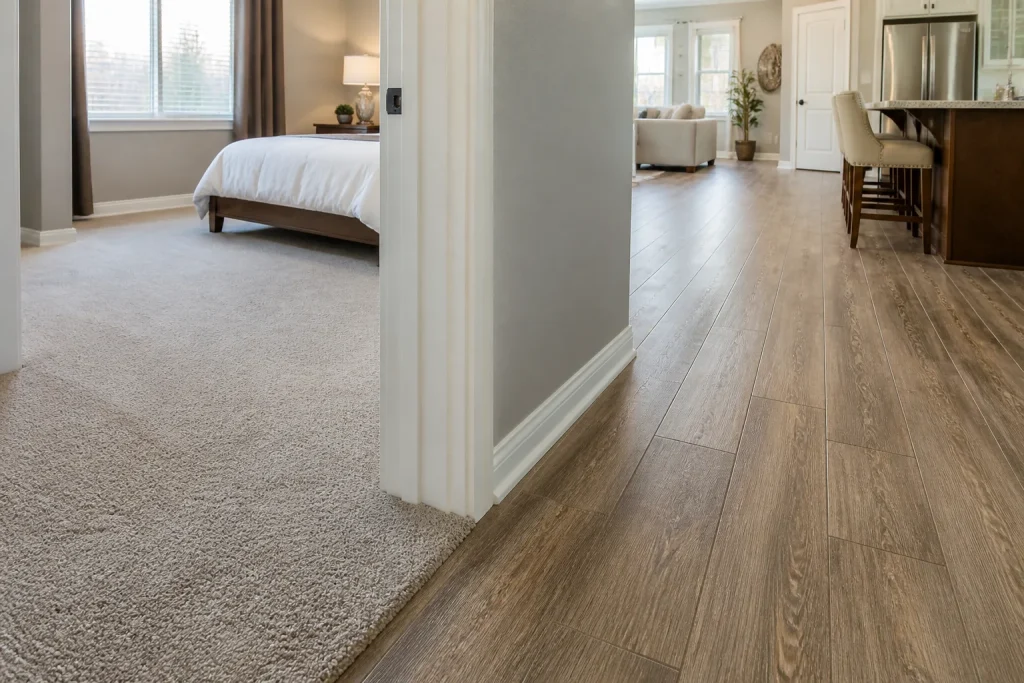
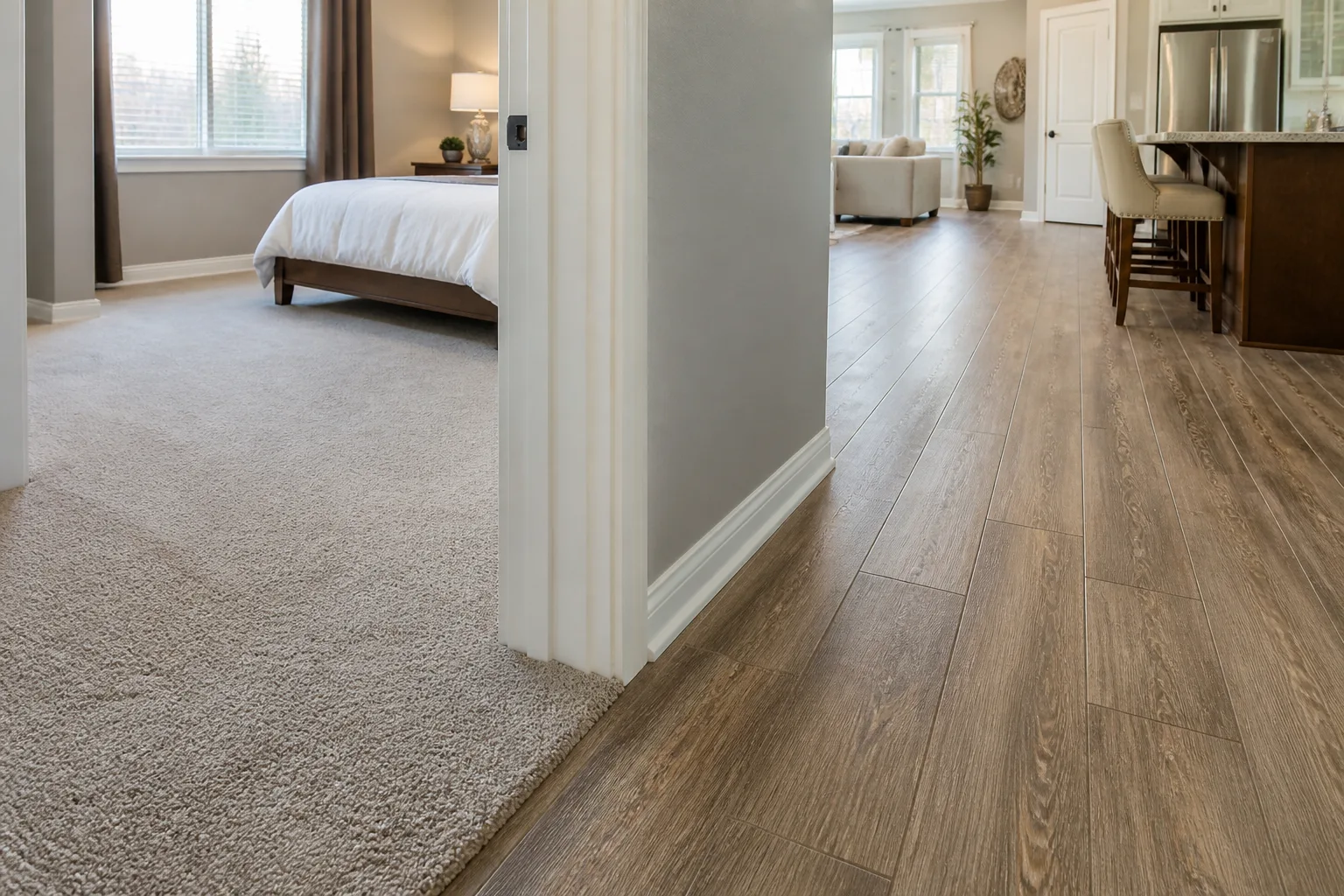
Hard flooring wins in a primary bedroom when aesthetic continuity with the rest of the home outweighs the acoustic trade-off. A bedroom adjoining an open hallway and an en-suite with the same engineered hardwood running through all three feels like one space. Carpet stops that flow at the threshold. Homeowners in Las Vegas who are renovating a whole floor often decide continuity matters more than the softened footstep.
The two hard-surface choices that work best in bedrooms are:
- Engineered hardwood. Real wood surface over a stable core, handles dry desert air better than many expect, and can sometimes be refinished depending on the thickness and condition. That’s checked at the estimate visit, not promised in advance.
- Luxury vinyl plank. Brands like COREtec and Karndean give the visual warmth of hardwood with resilient construction and a wear layer that stands up to pets and children. Water-resistant, not waterproof.
Both can be laid over most bedroom subfloors, and both are quieter underfoot with a quality underlayment. They won’t match carpet’s impact absorption – nothing hard does – but a rug beside the bed handles the worst of the cold-morning shock.
How does who sleeps there change the material choice?
The bedroom’s traffic profile should drive the purchase decision, and most buyers get this backwards. They pick a material first and then hope it fits the household. Instead, match the material to who uses the room.
- Single adult, low traffic. Nearly any material works. Carpet and hardwood are equally defensible. Pick on look and feel.
- Couple with a light sleeper. Carpet in the primary bedroom. The IIC advantage is the deciding factor.
- Children using the bedroom. Carpet in a durable branded fiber – Shaw and Mohawk both make residential carpet lines designed for high-traffic family use – or LVP with a harder wear layer. Carpet softens the inevitable falls; LVP handles the spills.
- Pets sleeping in the room. Luxury vinyl plank or laminate is easier to manage. Carpet works if it’s a low-pile, tightly-woven face and you accept more frequent cleaning. No carpet is pet-proof, and no hard floor is scratch-proof.
Think of it as matching the floor to the routine, not the showroom display. Our team can walk a Las Vegas bedroom and help match fiber type or wear layer to the actual household, and that conversation is free.
When should you call a pro?
Any bedroom floor above a garage, over an older concrete slab, or with visible subfloor variance should get a professional look before you buy material. Carpet installation needs a properly prepared surface and correct stretching to hold its edge. Hardwood needs moisture consideration and expansion gaps respected. Tile needs a subfloor that won’t flex underfoot. And if the existing bedroom floor is hardwood with enough thickness left, refinishing may be a better value than replacement – a question only an experienced eye can answer accurately.
If you’re in Las Vegas and want a floor that’s installed right and finished right, our team handles carpet installation, tile flooring installation, and hardwood refinishing, working with nine name-brand lines including Shaw, Karndean, and Daltile.
The Bottom Line
For most Las Vegas bedrooms, the answer follows the acoustic case: if the room needs quiet and warmth underfoot, carpet wins. If the room needs continuity with the rest of the home and a household with pets or regular spills, engineered hardwood or luxury vinyl plank is the better fit. The four variables – traffic, sound, temperature, allergens – decide it. Not the swatch catalog.
If you’re in Las Vegas and need help, Floors Las Vegas offers free estimates – call (844) 761-9353. We answer 24/7, with fast dispatch from 7am to 7pm, Sunday through Friday. Our technicians have up to 11 years of experience. You can also learn more on our Floors Las Vegas homepage, and see our coverage of the broader Las Vegas area.
Frequently Asked Questions
Carpet is better for bedrooms that need quiet and warm floors, because pile absorbs impact noise and softens cold-morning footing. Hardwood or luxury vinyl plank is better when bathroom and hallway visibility flow matters more than acoustic softness. The right answer depends on who sleeps in the room and how the room connects to the rest of the house. Call (844) 761-9353 for a free estimate on either.
Yes. Carpet with cushion absorbs impact noise at the source, while hard surfaces reflect it. That difference shows up in IIC and STC ratings, and for light sleepers it’s often the deciding factor. Luxury vinyl plank with an underlayment can soften some of it, but not to carpet’s level. Call (844) 761-9353 to walk through options.
Timing depends on the material and the room’s condition, and the schedule is set at the estimate visit. A single bedroom typically runs shorter than a full floor, but every job is different. The written estimate sets the plan. Call (844) 761-9353 and we’ll quote it.
Yes. We come out, measure, look at the subfloor, and give you a written price – no charge for that visit. That’s true for carpet, tile, and hardwood refinishing. Call (844) 761-9353 to book the appointment.
Written by the team at Floors Las Vegas.
Need Flooring Help?
Call Floors Las Vegas - licensed & insured, with free written estimates in Las Vegas.
(844) 761-9353